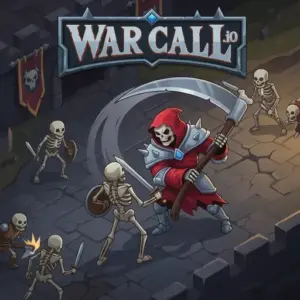
What are .IO games?
.IO games is a broad label for lightweight browser games that usually emphasise quick entry, simple controls and online competition. The name became associated with games hosted on .io domains, but the style has expanded beyond the domain extension. Today a game can be described as “.io-style” because of its arena, growth, survival or public-match structure even if its web address does not end in .io.
That is why GameBosh treats .IO Games as a gameplay category rather than a technical rule. Some titles are snake-style growth games, some use teams or territory, and others are shooters or battle arenas. What they often share is a low barrier to understanding the basic loop and a multiplayer environment that changes because other players are involved.
Common .IO game mechanics
Growth mechanics ask you to collect resources and become larger or stronger while avoiding players who can defeat you. Arena games put many competitors into a defined space and reward survival, score or eliminations. Territory games focus on controlling more of the map, while team games add cooperation and shared objectives. Some .io titles use rounds; others let players join an ongoing world.
These mechanics create tension because progress is visible but can often be lost quickly. A player who becomes too aggressive may expose themselves to a smaller opponent. A cautious player may survive longer but fall behind in score. Learning when to collect, attack, escape or reposition is usually more important than simply moving as fast as possible.
Practical strategy for growth and survival games
- Build safely at the start. Early resources are often easier to collect away from crowded areas.
- Keep an escape route. Do not enter a corner or dense group without knowing how you will leave.
- Watch player size and direction. The biggest threat may not be the nearest player if another competitor is cutting off your route.
- Do not chase forever. Pursuing one opponent can make you ignore resources, objectives and new threats.
- Use the map rhythm. Learn where players tend to gather and decide whether that area is an opportunity or a risk for your current size.
.IO games and multiplayer browser games
Most .io-style games sit naturally inside the wider Multiplayer Games topic, but the reverse is not true. A turn-based board game can be multiplayer without having anything in common with an .io arena. A local two-player sports game is multiplayer too, yet it may never connect to an online server. Keeping the .IO Games category separate helps players who specifically want fast public competition.
Use Multiplayer Games when you want a wider range of shared experiences. Use 2 Player Games when the group size is specifically two. This hierarchy gives each archive a clear purpose instead of creating duplicate pages for “online multiplayer games” with nearly identical content.
Why connection quality matters
Live .io games rely on frequent communication with a server. If latency is high, another player may appear to move suddenly or your action may be registered later than expected. Closing downloads and other bandwidth-heavy activities can help, but server location, Wi-Fi conditions and the game itself also affect responsiveness. A browser speed test cannot guarantee a particular game session will be smooth.
If a permitted title will not connect, refresh the page and check whether the official game service is experiencing problems. Privacy extensions, script blockers and managed networks can also prevent the connection. GameBosh should never recommend bypassing a school or workplace restriction simply to join a match.
Mouse, keyboard and touch controls
Snake-style .io games often use the mouse or touch direction, while shooters can require WASD plus mouse aim. Other arena games use only a few keys for abilities. Because the genre is mechanically diverse, there is no universal .io control scheme. The individual game page should list verified controls and explain unusual movement when that information is available.
Touch support also varies. A simple directional snake game can translate well to mobile, while a competitive shooter that expects precise cursor movement may be more comfortable on desktop. Screen size is particularly important in arenas because seeing threats early is part of the strategy.
Fair play and third-party tools
Competitive browser games are most enjoyable when everyone follows the same rules. Bots, automation scripts and modified clients can give unfair advantages and may violate a game's terms. GameBosh does not provide cheats or instructions for manipulating multiplayer clients. If an official game has reporting or moderation tools, use those channels for abusive behaviour or suspected cheating.
This is also why game-specific sourcing matters. A description should not promise anti-cheat systems, ranked matchmaking or account features unless the developer actually documents them. .IO games change frequently, so old third-party descriptions can become inaccurate.
Choosing an .IO game by play style
Choose a growth game if you enjoy building from a weak starting position. Pick an arena shooter if aim and movement matter more. Territory games suit players who like map control, while team-based modes can reward coordination. If you mainly want to play privately with one friend, a dedicated 2 Player or private-room game may be a better fit than a public .io lobby.
The category grid should let you reach those games quickly. Longer editorial text belongs below the games so the page remains useful to players first. Search phrases such as “free .io games” and “multiplayer browser games” can be covered naturally through accurate explanations instead of being repeated in every heading.
Why the .IO label still matters
Even though the label is no longer limited to the .io domain extension, it remains useful because players recognise a particular style of quick online play. The category can therefore act as a semantic bridge between Multiplayer, Action and Battle Games. Internal links should reflect those real relationships, and individual game pages should own the specific game-name queries.
GameBosh uses this hub to organise playable .io-style titles, explain common mechanics and help players choose by interaction rather than hype. That creates more information value than treating every online game as interchangeable simply because it runs in a browser.